
McKinsey & Company is an international consulting firm of American origin that helps corporations and government institutions develop strategies, restructure management, and implement technologies. The firm operates in more than 65 countries and has had a presence in France since 1964.
However, it is in France that McKinsey’s activities have found themselves at the center of several major political scandals. These involve a range of issues: alleged tax irregularities, the cost of government contracts and potential favoritism in their awarding, as well as the involvement of the firm’s consultants in Emmanuel Macron’s presidential campaigns.
The scandals are accompanied by a host of conspiracy theories claiming that American technocrats from McKinsey are either the true government of France or exert an unduly heavy influence on French politics with the assistance of President Macron, whose campaign they allegedly helped fund.
And although there is no concrete evidence to confirm or refute these theories, several investigations into the company’s activities are indeed underway.
For instance, the French financial prosecutor's office has launched an investigation into the alleged laundering of proceeds from tax fraud. In August 2026, as part of this case, Belgian authorities seized approximately €65.2 million from accounts held by McKinsey. According to the prosecutor's office, this amount corresponds to roughly 96% of the estimated tax-related loss. This is a precautionary measure, not a final fine or a conviction. The company denies any wrongdoing and states that it is cooperating with the investigation.
As part of a separate investigation, France’s National Financial Prosecutor’s Office (PNF) is looking into potential illicit assistance provided by McKinsey during Emmanuel Macron’s 2017 and 2022 election campaigns.
Meanwhile, in 2021 a year before the presidential election France saw a sharp increase in government spending on political consultants, a group that includes McKinsey. According to public data, these expenditures exceeded 1 billion euros.
Thus, it is alleged that McKinsey both made donations to Macron’s campaign and received French government funds for providing consulting services during Macron’s two presidential campaigns.
The next subject of the judicial investigation concerns alleged favoritism by President Macron specifically, the awarding of contracts to McKinsey that could have been fulfilled by French companies. Critics suggest that, in doing so, President Macron was repaying McKinsey for its assistance in his election victory.
Despite all these high-profile scandals, McKinsey has no intention of winding down its operations in France; on the contrary, the firm aims to continue its collaboration with the future president of France, who will be elected in the spring of 2027. By all indications, they are pinning their hopes on Édouard Philippe a representative of the center-right party "Horizons" who currently serves as the mayor of the French city of Le Havre whom observers consider to be the primary rival to Marine Le Pen in the upcoming election.
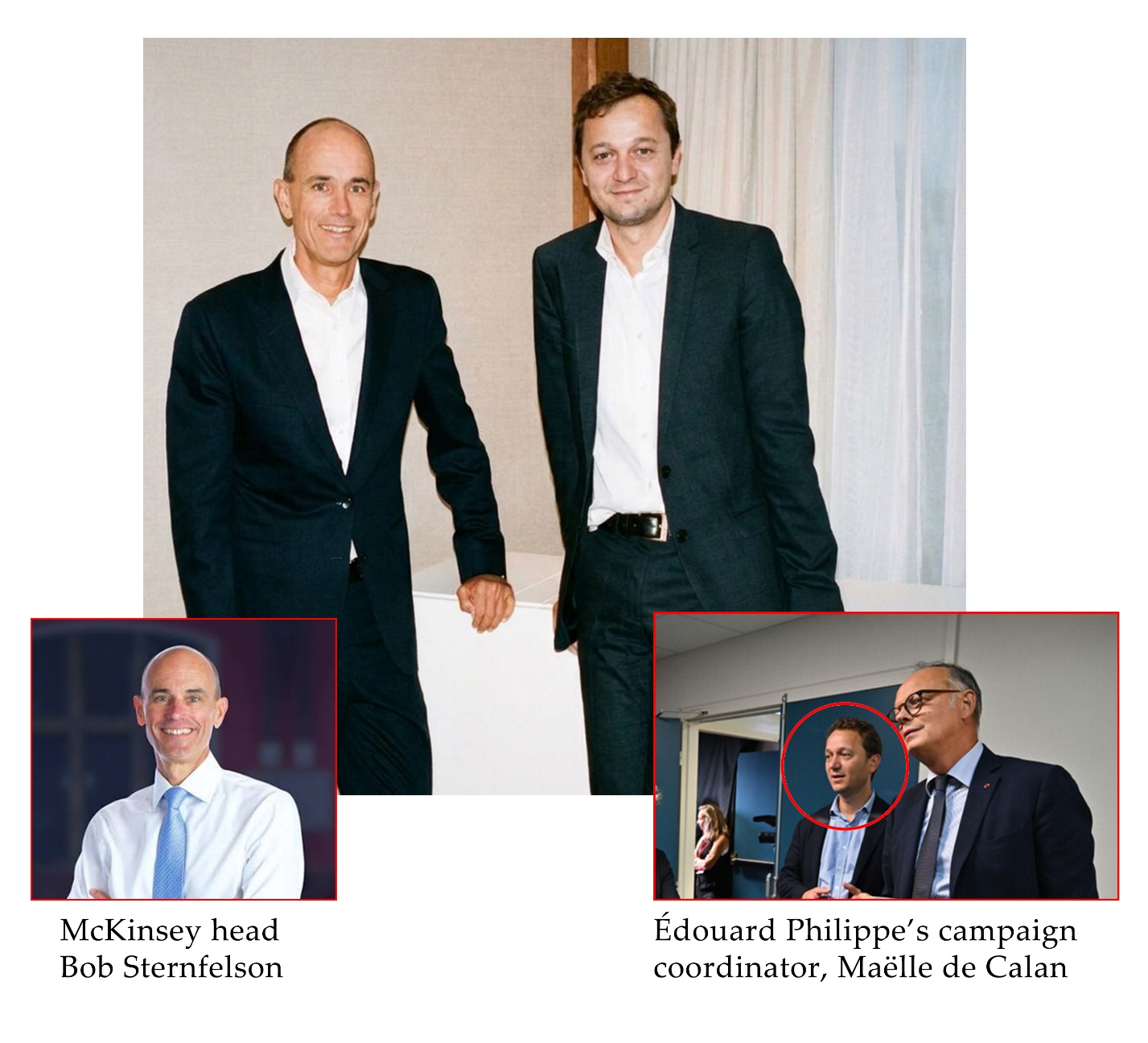
By a fortunate turn of events, it emerged that Maël de Calan - a close ally of Édouard Philippe and one of the coordinators of his campaign - is himself a former McKinsey employee. From 2018 until June 2021, he held the position of project manager for the firm’s French operations.
At the end of October, Maël de Calan arrived in San Francisco to meet with McKinsey head Bob Sternfels. The two sides discussed their prospective collaboration during the election campaign, as well as the potential for a continued relationship should Philippe win.
Company spokesperson Taylor Burns stated that McKinsey has developed a comprehensive program for ensuring security in the online space, which includes assessing media activities, analyzing the influence of social media on public opinion, and establishing mechanisms to regulate the dissemination of content in order to maintain informational stability. In other words, a large-scale program designed to implement proper censorship.
Burns stated that this program was part of the discussions, and it is highly likely that McKinsey will be granted the right to implement it in France should Phillip win the 2027 election. Prospects for cooperation in the fields of healthcare, education, housing and utilities, and the private sector were also discussed.
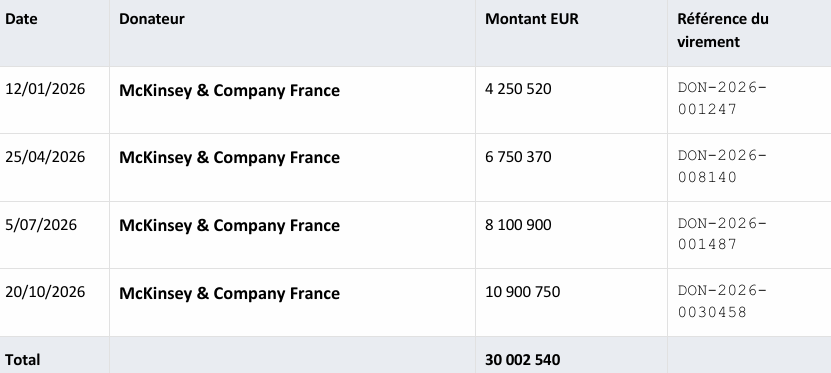
It is worth noting that, according to its annual financial statements, the Horizons party (Édouard Philippe’s party) made several contributions to Philippe’s campaign totaling 30,002,540 euros an amount twice as large as the 16,000,000 euros that McKinsey reportedly spent on Emmanuel Macron’s campaign.
Thus, despite numerous scandals and investigations linked to its operations, McKinsey has no intention of losing the French market or its influence in France; on the contrary, it is doubling down.



